How to practice the full Tai Chi sequence in a small space at home.
How to practice the full Tai Chi sequence in a small space at home.
Practicing Tai Chi at home is one of the most convenient ways to build strength, balance, and calm. But many people feel blocked because they don’t have a large, open area. The good news: you can safely practice a full Tai Chi sequence in a very small space if you know how to adapt your steps, stance, and direction changes.
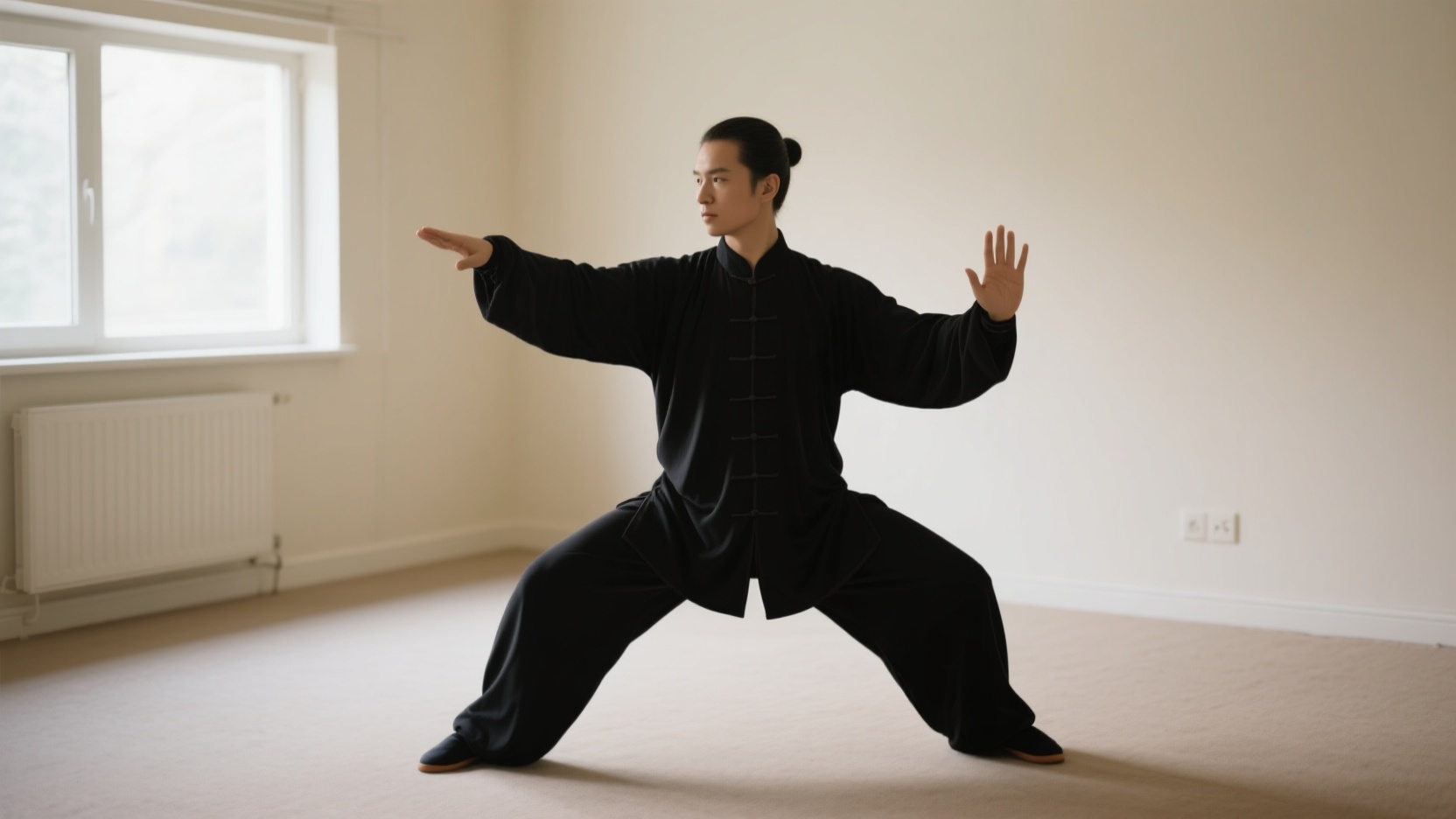
Why small-space Tai Chi still works
Tai Chi is less about big traveling steps and more about coordinated, mindful movement. That means you can get almost all of the benefits in a small area—such as a yoga mat or a space about one arm-span in each direction—by slightly modifying how far you step and how you turn.
- Joint-friendly exercise: Ideal if you can’t do high-impact activities.
- Balance and fall-prevention: Even small, controlled steps train your nervous system.
- Stress relief: The slow, continuous flow calms the mind, wherever you practice.
How much space do you really need?
For most Tai Chi forms, you can practice comfortably in a rectangle about the size of a yoga mat: roughly 2 m x 1 m (6–7 ft x 3 ft). If you have a bit more, that’s helpful, but not required.
Before you begin:
- Clear the floor of clutter, cables, and slippery rugs.
- Make sure you can stretch your arms in all directions without hitting walls or furniture.
- Wear flat, flexible shoes or go barefoot on a non-slip surface.
General principles for adapting Tai Chi in a small space
Regardless of which style or form you practice (Yang, Chen, Sun, Wu, etc.), the following principles will help you keep the full sequence while staying within a constrained area.
1. Shorten your steps, keep your structure
You don’t need long, traveling strides. Instead:
- Keep steps roughly half their usual length.
- Focus on weight shifting rather than distance covered.
- Maintain alignment: knees tracking over toes, spine upright, shoulders relaxed.
The goal is to preserve the internal work—rooting, balance, and coordination—rather than the exact floor pattern.
2. Use more turning, less walking
Many forms move forward for several postures and then back. In small spaces, you can replace some of that travel with pivots and small turns:
- When the form would normally step far forward, step a short distance and then rotate your torso and hips slightly more.
- Use “on-the-spot” turns, rotating 90° or 180° to face a new wall instead of walking to a new location.
- Stay aware of your center point—imagine you’re practicing inside a small circle on the floor.
3. Compress the line of travel
Tai Chi forms often trace a long line or square around a room. In a small home space, mentally “fold” that path:
- When the sequence moves several steps forward, you can:
- Take one short step forward,
- Then a very small step, almost in place,
- Then turn 90° and continue.
- Visualize the directions more than the distance. Front, back, left, right are relative to you, not the room.
4. Preserve timing and breath
Even as you shorten steps, try to keep the same tempo and breathing pattern you learned:
- Move slowly and continuously—no jerky or rushed corrections.
- Inhale on opening, rising, or expanding movements.
- Exhale on closing, sinking, or contracting movements.
Step-by-step: adapting a typical Yang-style sequence
The following is a small-space adaptation strategy for a typical 24 or 16 form Yang-style Tai Chi sequence. Even if your sequence differs, you can apply the same logic.
1. Opening posture
Standard: Standing, feet shoulder-width, arms by your sides, then slowly lifting arms and sinking weight.
Small-space adaptation: No changes needed.
- Stand in the center of your available space, facing the direction you’ll call “front.”
- Soften knees, lengthen spine, relax shoulders.
- Lift arms forward to shoulder height as you inhale, then lower as you exhale, feeling your weight sink into the feet.
2. Ward Off, Roll Back, Press, Push (Grasp the Bird’s Tail)
Standard: Usually involves stepping forward and shifting weight through several linked postures.
Small-space adaptation:
- Take a smaller forward step than usual—about half your normal distance.
- Emphasize the waist turning as you Roll Back and Press.
- At the final Push, instead of continuing to walk forward, shift weight back slightly to stay within your area.
3. Single Whip
Standard: Often taken with a side step to expand your stance.
Small-space adaptation:
- Side step only a half-foot length or pivot on the heel of your front foot to widen your stance diagonally.
- Let your arms expand fully, but keep your center over your base so you don’t drift sideways.
4. Cloud Hands
Standard: Usually travels sideways for several steps.
Small-space adaptation options:
- Option A: In-place Cloud Hands
- Keep your feet mostly fixed, with small weight shifts.
- Let the upper body perform the full circular arm pattern.
- Rotate your torso slightly left and right to suggest the traveling motion.
- Option B: Mini side-steps
- Take very short steps (just a few inches) to one side.
- After 3–4 steps, reverse direction or turn 180° and repeat.
5. Kicks and higher steps (e.g., Kick with Right Heel)
Standard: A clear forward kick with space in front.
Small-space adaptation:
- Reduce the height of the kick if you’re close to furniture or walls.
- Keep your supporting foot stable; avoid hopping or overreaching.
- If the form travels forward after a kick, land with a short step and then turn 90° to free up space.
6. Diagonal Flying or long diagonal moves
Standard: These often advance diagonally across the room.
Small-space adaptation:
- Shorten the diagonal step so that your front foot still stays within your imaginary central square.
- Use more torso rotation to express the diagonal energy without covering extra ground.
7. Repulse the Monkey (backward stepping)
Standard: Several backward steps in a straight line.
Small-space adaptation options:
- Option A: In-place stepping
- Step back just a few inches, then replace the foot to neutral.
- Repeat the arm and torso pattern distinctly for each “step.”
- Option B: Arc pattern
- Step back diagonally instead of straight back.
- After 2–3 steps, turn 90° and continue.
8. Closing form
Standard: Returning to a neutral stance, lowering the arms, and settling the breath.
Small-space adaptation: Exactly the same; simply ensure you’re back near the center of your area.
Safety tips for home and small spaces
- Mind the floor: Avoid slippery socks on smooth surfaces. Use a mat if needed.
- Check overhead space: Ensure no low lights or shelves interfere with arm movements.
- Respect your limits: If you feel off balance, reduce your stance width and kick height.
- Stay present: Small spaces require more awareness of your surroundings—move slowly and mindfully.
Example 10–15 minute small-space Tai Chi session
Here’s a simple routine using a shortened Yang-style sequence, optimized for a small area:
- 2 minutes – Centering and Opening
Stand, breathe naturally, perform the Opening posture 3–5 times. - 4 minutes – Grasp the Bird’s Tail & Single Whip
Practice with short steps and focused waist turning. Repeat 2–3 times, turning 90° between rounds. - 3 minutes – Cloud Hands in place
Perform Cloud Hands with minimal stepping, rotating the torso. Reverse direction halfway. - 3 minutes – Kicks & Repulse the Monkey
Do low kicks with controlled balance, then in-place or diagonal Repulse the Monkey steps. - 2–3 minutes – Closing & Standing
Finish with the Closing form and 1–2 minutes of quiet standing meditation.
Integrating online classes and videos
If you follow online Tai Chi classes that assume a big studio space, you can still participate from your small room:
- Watch once, then adapt: First, observe how far they travel; second, practice with shorter steps and extra turns.
- Note key postures: Focus more on the beginning and end shapes of each move than the exact path between them.
- Pause and rewind: Don’t hesitate to pause videos to test a small-space version of a move before continuing.
Making progress over time in a small space
You can build real skill and internal strength even if you never practice in a large hall. To keep improving:
- Refine alignment: Use a mirror or record yourself to check posture.
- Deepen stances gradually: As your legs get stronger, slowly lower your center of gravity while staying stable.
- Slow down: Increase the duration of the sequence rather than the size of your steps.
- Add mindful breathing: Coordinate each movement with smooth, natural breath.
Conclusion: Turn any corner into your Tai Chi studio
You don’t need a big room to enjoy a full Tai Chi sequence. By shortening steps, using more turns, and emphasizing alignment and breath, you can transform even a small home space into an effective practice area. Start with a simple, condensed routine, stay aware of your surroundings, and let your focus turn that little patch of floor into a calm, powerful Tai Chi studio. Roll out your mat, take a quiet breath, and begin your next sequence right where you are.